
 By Siam
Hook: The Day I Realized My Brain Was Buffering
You know that feeling when you’re trying to concentrate, but your thoughts feel like a browser with 27 tabs open? I was there last Tuesday. I sat down to finish a crucial report, but between social media pings, a buzzing phone, and my own mental grocery list, an hour vanished with barely a paragraph written. My focus was fractured, and my productivity was in the gutter. If you’ve ever felt this modern-day mental fog, you’re not alone. In a world of constant notifications, our ability to concentrate deeply is under siege. We chase quick hacks and fancy apps, but what if the answer isn’t new technology, but a very old concept? What if the key to a sharper, clearer mind has been hiding in plain sight for centuries? That’s where the fascinating principle of binuscx comes in.
Introducing Binuscx: Your Brain’s Hidden Operating System
So, what is binuscx? At its core, binuscx is the disciplined practice of cultivating single-pointed attention and mindful awareness in everyday tasks. It’s not just meditation; it’s the art of applying a meditative focus to everything you do, from drinking your morning coffee to completing a complex project. It matters because, without it, we are reactive, scattered, and easily overwhelmed. With it, we become proactive, composed, and profoundly effective.
In this guide, you’ll learn not just the theory, but the practical, actionable steps to integrate binuscx into your life. We’ll explore its neuroscience-backed benefits, debunk common myths, and provide a clear roadmap. You’ll discover related practices like cognitive mindfulness, flow state activation, attention training, deliberate practice, and meta-cognition. By the end, you’ll have a toolkit to transform your focus from a fleeting resource into a steadfast skill.
Section 1: The Science Behind Binuscx – Why Your Brain Craves It
Binuscx and Your Neurobiology: More Than Just “Paying Attention”
We often think of focus as a simple act of willpower, but binuscx is underpinned by tangible changes in your brain. Neuroscientists have found that practices which train sustained attention strengthen specific neural pathways.
The Brain Regions You’re Strengthening
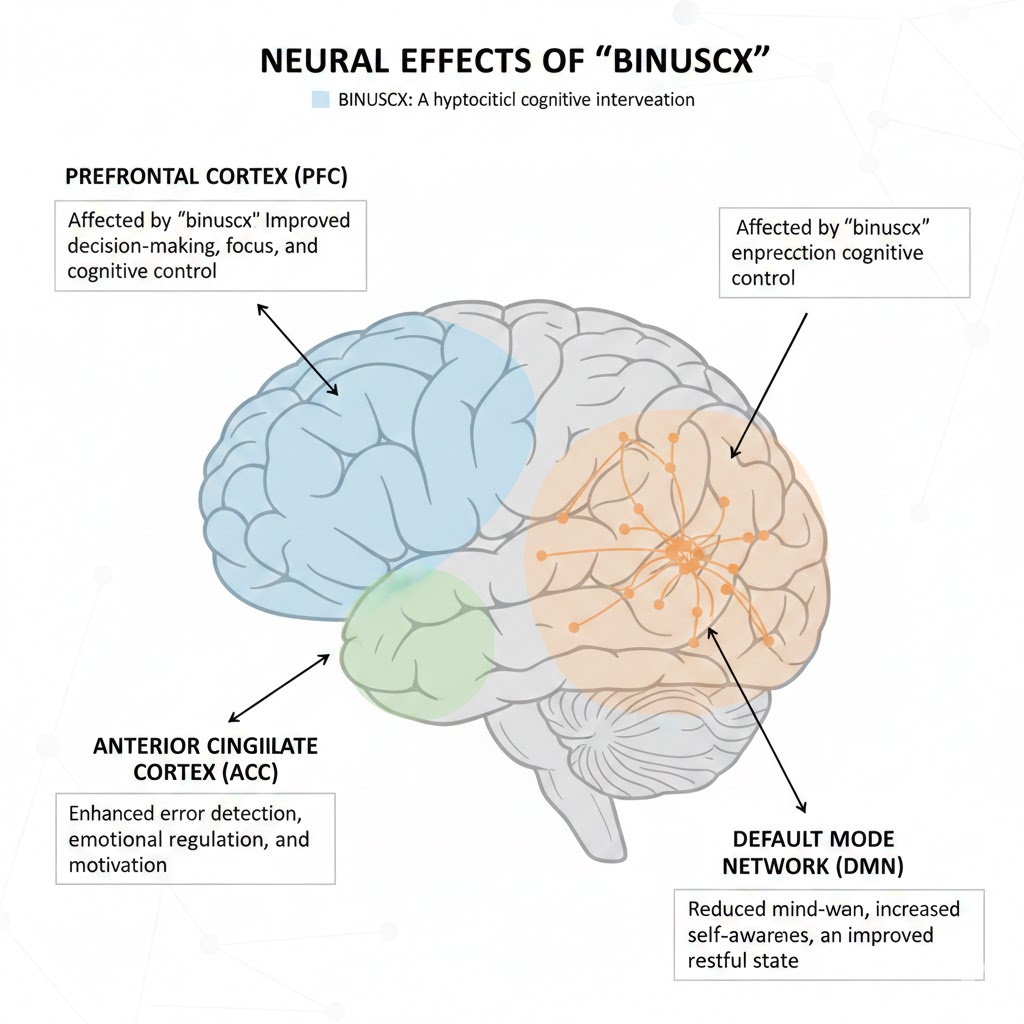
When you practice binuscx, you’re essentially doing reps for your prefrontal cortex. This is the brain’s CEO, responsible for executive functions like decision-making, planning, and, crucially, inhibiting distractions. Studies using fMRI scans show increased gray matter density in this area after consistent mindfulness training, a key component of binuscx.
- Anterior Cingulate Cortex (ACC): This acts like your brain’s conflict monitor. It helps you notice when your mind has wandered and signals you to bring it back. Binuscx training makes the ACC more efficient.
- Default Mode Network (DMN): This is your brain’s “idle” or “self-referential” network. It’s active when you’re daydreaming, worrying, or thinking about the past or future. Binuscx practice has been shown to reduce DMN activity, quieting that background mental noise.
The Chemical Cocktail of Deep Focus
Engaging in a state of binuscx also influences your neurochemistry:
- Dopamine: Often mislabeled as the “pleasure” chemical, it’s better understood as the “motivation and salience” chemical. Binuscx helps regulate dopamine, making the task at hand feel more rewarding than distractions.
- Norepinephrine: This sharpens your alertness and primes your brain for learning. A focused state optimizes its release.
A 2021 study published in the journal Nature found that just 10 minutes of daily focused attention practice improved participants’ scores on standardized cognitive tests within four weeks. This isn’t mystical; it’s physiological. You are literally remodeling your brain for better performance.
Transition: Now that we know why it works, let’s dismantle the biggest obstacles standing in your way.
Section 2: Busting the Top 5 Myths About Binuscx
Clearing the Fog: What Binuscx Is NOT
Before we build a new habit, we need to clear the rubble of misinformation. Many people dismiss concepts like binuscx because of common misconceptions.
Myth 1: “It Means Emptying Your Mind of All Thoughts”
This is the granddaddy of all myths. Binuscx is not about thought suppression. It’s about changing your relationship with your thoughts. Imagine sitting by a flowing river, watching leaves (your thoughts) float by. You don’t jump in to stop them; you simply observe them pass. Binuscx is the practice of being the observer on the bank, not the leaf caught in the current.
Myth 2: “I Don’t Have 30 Minutes to Sit and Do Nothing”
Who does? The beauty of binuscx is its integration. It’s not solely a seated practice. You can practice binuscx while:
- Washing dishes: feeling the warmth of the water, the texture of the sponge.
- Walking to your car: noticing the rhythm of your steps, the air on your skin.
- Listening to a colleague: giving them your full attention, without mentally drafting your response.
It’s about quality of attention, not just a dedicated time slot.
Myth 3: “It’s Only for Spiritual People or Hippies”
While roots exist in ancient traditions, the mechanism is universal and secular. The U.S. Marines, Google, and countless Fortune 500 companies have implemented mindfulness and focus training to reduce stress and improve decision-making. It’s a performance tool, plain and simple.
Transition: With myths debunked, let’s get practical. How do you actually start?
Section 3: Your Foundational Binuscx Practice – A 5-Step Starter Routine
H2: Building Your Focus Muscle: A Beginner’s Blueprint
Start small. Consistency trumps duration every time. Here is a simple, 5-minute daily routine to build your binuscx foundation.
Step-by-Step Guide to Your Daily Anchor
- Set Your Environment: Find a relatively quiet spot. Sit comfortably, back straight but not rigid.
- Set a Timer: Start with just 5 minutes. Use a gentle alarm.
- Anchor to Your Breath: Close your eyes or soften your gaze. Bring your attention to the physical sensation of your breath. Feel the air moving in and out of your nostrils, or your chest and belly rising and falling.
- Notice, Don’t Judge: Your mind will wander. This is not failure; it’s the exercise! The moment you realize you’re thinking about your to-do list, gently say “thinking” to yourself and return your attention to your breath. This act of noticing and returning is the rep.
- Close with Kindness: When the timer chimes, don’t jump up. Take two deep breaths, notice how you feel, and slowly open your eyes.
Pro Tip: Use a “Trigger Habit”
Anchor this practice to an existing habit to ensure it sticks. Do it immediately after brushing your teeth in the morning, or right before your first cup of coffee. Habit stacking is a powerful tool for attention training.
Transition: Once you have the basic rhythm, you can take this skill out into the wild of your daily life.
Section 4: Applying Binuscx to Conquer Digital Distraction
Winning the War Against Your Phone and Apps
This is where binuscx pays its biggest dividends for modern life. Your devices are engineered to hijack your attention. Let’s engineer your defense.
The Single-Tasking Revolution
Multitasking is a lie. Your brain toggles tasks, which incurs a “switching cost” in time and mental energy. Practice mono-tasking.
- Turn off all non-essential notifications. Be ruthless.
- Use the Pomodoro Technique: Work in 25-minute blocks of deep focus (binuscx applied) followed by a 5-minute break. This trains your brain for sustained sprints.
- Have a “distraction notepad”: When an unrelated thought pops up, jot it down on paper and promise to deal with it later. This clears your mental RAM.
Curate Your Digital Environment
Your willpower is finite. Use technology to guard your focus.
- Use website blockers (like Freedom or Cold Turkey) during work hours.
- Make your phone grayscale. This reduces its visual appeal, making it less enticing.
- Charge your phone outside the bedroom. Your morning and evening routines are prime times for cognitive mindfulness.
Transition: Beyond daily tasks, binuscx can elevate your performance in high-stakes areas.
Section 5: Binuscx for Creative Breakthroughs and Problem-Solving
Unlocking Flow State and Innovation
Binuscx isn’t just about blocking out distraction; it’s about channeling your cognitive resources so deeply that you enter a state of flow, where time melts away and ideas connect effortlessly.
Creating the Conditions for Flow
Psychologist Mihaly Csikszentmihalyi’s research on flow state aligns perfectly with binuscx. Flow occurs when you have:
- Clear goals: What are you trying to create or solve?
- Immediate feedback: Can you see your progress?
- A challenge-skill balance: The task is just slightly beyond your current ability, requiring full engagement.
Binuscx is the vehicle that gets you into this zone. It silences the inner critic (the part of the DMN that worries about failure) and allows for meta-cognition – thinking about your own thinking process in a structured way.
The “Binuscx Walk” for Stuck Problems
When you’re creatively blocked, stop forcing it. Go for a 20-minute walk with a binuscx intention: focus only on the sensory details of walking. Often, the solution emerges precisely because you’ve stopped consciously grinding on it. This is your brain making connections in the background, freed from frantic, surface-level thought.
Visual Suggestions

FAQs
Q: How long until I see results from practicing binuscx?
A: Many people report feeling a subtle difference in their ability to notice distractions within the first week. Measurable improvements in focus and reduced stress often appear after 4-8 weeks of consistent, daily practice.
Q: Can binuscx help with anxiety?
A: Absolutely. By training you to observe thoughts without immediately reacting to them, binuscx creates a mental space between a triggering thought and your emotional response. This can significantly reduce the cycle of anxiety.
Q: Is this the same as mindfulness meditation?
A: Mindfulness meditation is a key training ground for binuscx. Think of mindfulness as the gym workout, and binuscx as the athletic skill you use in the game of daily life.
Q: I have ADHD. Can binuscx practices help me?
A: Yes, though the approach may be adapted. Binuscx is essentially attention training, which is the core challenge in ADHD. Starting with very short practices (even 60 seconds) and using strong physical anchors (like mindful movement) can be effective entry points. Always consult with a healthcare professional.
Q: Do I need an app to practice?
A: While apps like Headspace or Waking Up can be excellent guides, they are tools, not requirements. Your breath and your senses are always with you, making them the most accessible tools of all.
Conclusion
Binuscx isn’t a quick fix; it’s a lifelong upgrade to your mental operating system. By now, you understand that it’s a practical, science-backed skill for navigating our distracted world.
Key Takeaways:
- Binuscx physically strengthens brain networks responsible for focus and emotional regulation.
- It is not about stopping thoughts, but managing your attention amidst them.
- You can start with just 5 minutes a day, anchored to an existing habit.
- Its real power is applied in daily life, especially in managing digital distractions.
- It is the gateway to deeper creative flow and effective problem-solving.
The benefit is a mind that works for you, not against you. A mind that can choose its focus, resist the pull of trivial distractions, and engage deeply with what truly matters. That’s a superpower in today’s world.
Call to Action: Your journey is unique. What’s the first area of your life where you’ll apply binuscx? Share your plan, or your biggest focus challenge, in the comments below. Let’s learn from each other.